Valuation Guide
Is my transformer electrically OK?
This is the question that decides whether your unit is priced as equipment or as metal. You do not need to answer it yourself — but you should know what a buyer is asking, and why it moves the number so much.
Why this one question dominates
Working units get a market. Failed units get a scale.
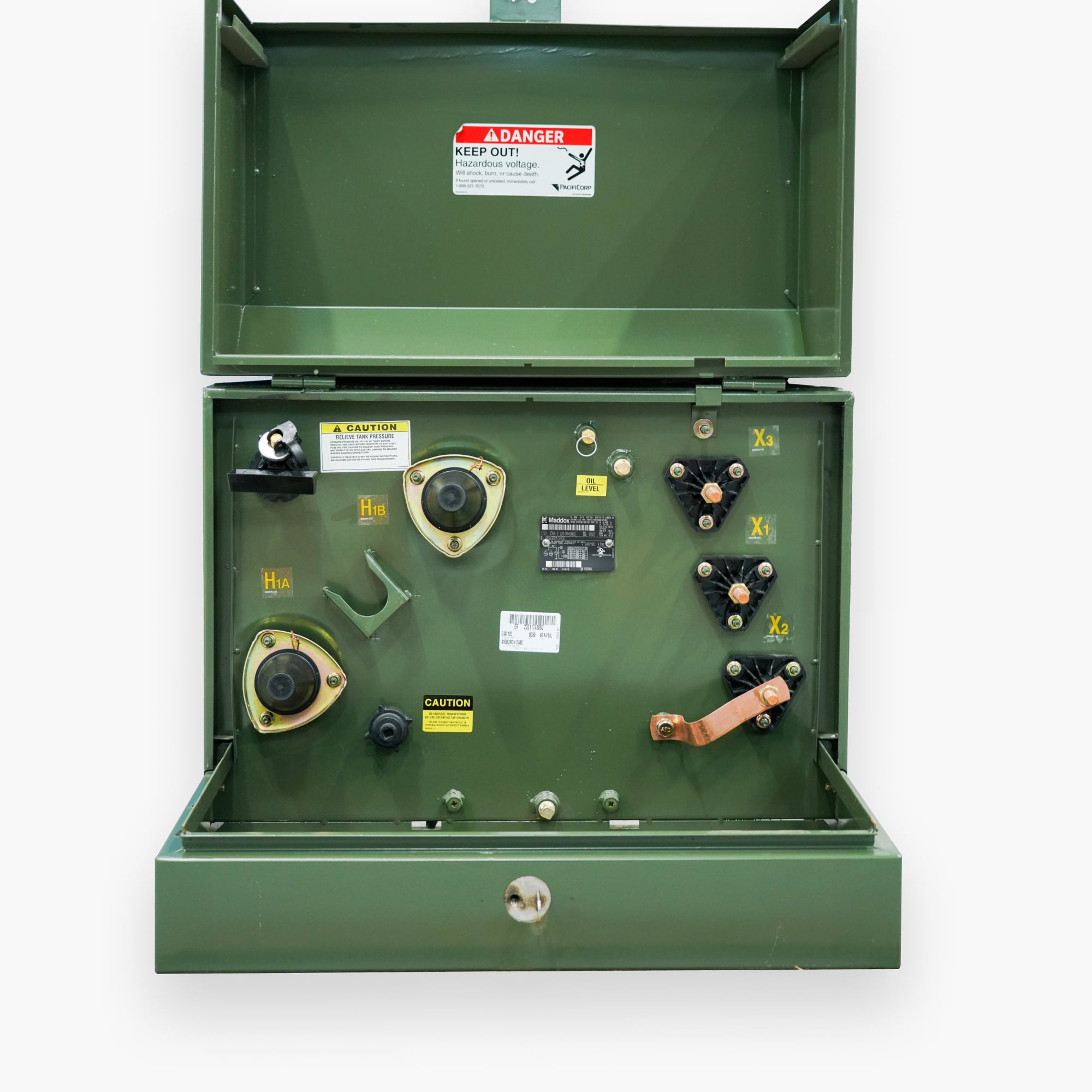
A transformer that passes electrical testing can be redeployed or remanufactured, so it competes with the cost and lead time of a new unit. One that fails testing has one remaining market — material recovery — and that market pays by weight. Maddox, a remanufacturer, states publicly that it pays 2–5 times the scrap value for units it can rebuild, which is a reasonable proxy for how much this single distinction is worth.
The industry shorthand for a unit that passes is EOK, short for "electrically OK". It is not a formal certification; it is a working shorthand meaning the unit's windings and insulation test sound and it steps voltage as the nameplate claims.
The four measurements
What a technician actually checks
Acceptance limits for these tests are defined in the IEEE C57 family of standards for liquid-immersed and dry-type transformers. We are not reproducing thresholds here, because the correct limit depends on the unit's class, temperature, and test conditions — read them from the standard or have a testing firm interpret the results.
Transformer turns ratio (TTR)
Confirms the unit actually steps voltage the way the nameplate says it does, within the tolerance set by IEEE Std C57.
Insulation resistance (megger)
Checks that the winding insulation is still sound and is not leaking to ground or between windings.
Winding resistance
Finds broken strands, loose internal connections, and shorted turns that a turns-ratio test alone can miss.
Oil sample (liquid-filled units)
Screens the fluid for internal faults through dissolved gas analysis, and screens for PCB content.
Safety, not sales talk: transformer testing involves stored energy and, on liquid units, hot oil. Do not open, energize, or test a transformer unless you are qualified to do so under your site's electrical safety program. If you are not, skip to the section below — you can sell the unit without testing it yourself.
No test equipment? Read these instead
What you already know is usually enough to start
Most sellers we talk to have never megger-tested anything, and that is fine. The history of the unit tells a buyer most of what a first-pass valuation needs. Be straightforward about it — a seller who says "it tripped and we replaced it" gets a better process than one who says "runs great" about a unit that does not.
It was energized and carrying load when it came out of service
The strongest single indicator you can give a buyer. A planned removal — a demolition, an upgrade, a plant closure — usually means the unit was fine.
It tripped, smoked, or was removed after a fault
Treat it as failed until testing says otherwise. Burned windings are common after a fault and are visible in an insulation test long before anything is visible to the eye.
Visible oil leaks, or the tank is low on fluid
A leak alone does not condemn a unit, but a unit that ran low on fluid may have overheated internally. Testing settles it.
It sat outdoors, de-energized, for years
Moisture ingress is the concern. Insulation resistance testing is the deciding measurement here, not appearance.
Rust on the tank or cabinet
Cosmetic in most cases. Surface corrosion has far less bearing on value than test results do.
You have no idea — the unit came with the building
Extremely common and not a problem. Send the nameplate and say so honestly; a buyer would rather test it than have you guess.
You do not have to test it to sell it
Send the nameplate and the unit's history as you know it. We evaluate every unit for remanufacturing potential first, and we handle testing on our end. Freight is on us in all 50 states either way.
Sources
- [1]IEEE Std C57.12.00 — Standard for Liquid-Immersed Distribution, Power, and Regulating Transformers — The standard that defines general requirements and test procedures for liquid-immersed transformers, including turns-ratio tolerance
- [2]IEEE Std C57.12.01 — Standard for Dry-Type Distribution and Power Transformers — The equivalent general-requirements standard covering dry-type transformers
- [3]Maddox — Recycle Surplus Transformers for 5X Their Scrap Value — A remanufacturer's published statement that it pays 2–5 times scrap value for units it can rebuild and resell (published October 31, 2023)